
Military Aviation Market: Recent Developments Shaping 2026
23 Oct 2026 • by Natalie Aster
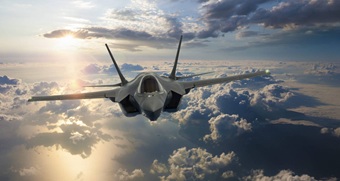
The military aviation market in 2026 is being reshaped by a combination of higher defense spending, accelerated aircraft procurement, new-generation fighter programs, and growing demand for unmanned and networked combat systems. Rather than concentrating exclusively on acquiring individual platforms, defense ministries are increasingly investing in integrated air-combat ecosystems combining crewed aircraft, drones, sensors, electronic warfare, data links, and long-range weapons.
Rising geopolitical tensions are reinforcing this investment cycle. European NATO members and Canada increased core defense expenditure by nearly 20% in 2025, while spending commitments are translating into new aircraft, surveillance platforms, and production capacity.
Sixth-Generation Fighters Move from Concepts to Major Contracts
One of the most significant military aviation market trends is the transition of sixth-generation fighter programs toward full-scale development.
In September 2026, Boeing secured a contract worth more than USD 20 billion to develop the U.S. Navy's F/A-XX carrier-based fighter. The program will initially produce test aircraft for airworthiness, systems, ground, and weapons-integration testing. Boeing is already developing the U.S. Air Force's F-47, giving the company a central position in two major U.S. next-generation combat-aircraft programs.
Europe and Asia are advancing competing initiatives. In July, the UK, Italy, and Japan awarded a GBP 4.6 billion contract to Edgewing for the next development stage of the Global Combat Air Programme (GCAP), which targets entry into service from 2035. The UK alone plans to invest GBP 8.6 billion in the program over four years. Canada also became GCAP's first Observer Nation in July 2026.
Meanwhile, the European FCAS fighter project has undergone major restructuring. France is moving toward a national future combat aircraft program, while German and Spanish companies have organized around the separate Team Gen 6 initiative. The change illustrates how industrial leadership, technology ownership, and workshare are becoming as important as aircraft specifications in future fighter programs.
F-35 Production Demonstrates the Scale of Current Fighter Demand
While sixth-generation aircraft dominate long-term planning, current demand remains heavily concentrated on established fifth-generation platforms.
Lockheed Martin delivered a record 191 F-35 fighters in 2025, compared with the previous record of 142. The global fleet approached 1,300 aircraft, highlighting the scale of the program's manufacturing, sustainment, and modernization ecosystem. Technology Refresh 3 provides the computing foundation required for future Block 4 capabilities, including upgraded sensors, electronic warfare, weapons integration, and processing capacity.
This installed base creates a substantial long-term market not only for aircraft production but also for software upgrades, engines, maintenance, training, weapons, and mission systems.
B-21 Production & Unmanned Systems Expand the Market
Strategic aviation is also entering a new investment phase. Northrop Grumman reached an agreement with the U.S. Air Force in early 2026 to increase B-21 Raider production capacity and production rates. The company expects to invest approximately USD 2.5 billion over several years to support expansion.
At the same time, unmanned systems are moving deeper into mainstream force structures. NATO announced procurement of Northrop Grumman Triton uncrewed aircraft for maritime surveillance in July, alongside Saab GlobalEye aircraft for airborne early warning and control.
The next growth opportunity extends further toward collaborative combat aircraft, designed to operate alongside crewed fighters. These platforms could perform reconnaissance, electronic warfare, weapons carriage, and high-risk missions while increasing the combat mass available to air forces.
Final Thoughts
The military aviation market is therefore moving toward a prolonged modernization cycle. Fifth-generation fighter procurement will remain important, but investment is increasingly shifting toward sixth-generation aircraft, autonomous systems, advanced sensors, electronic warfare, and connected combat networks.
For aerospace manufacturers and suppliers, the strongest opportunities are likely to emerge where aircraft production intersects with software, propulsion, mission electronics, unmanned platforms, weapons integration, and lifecycle support. Military aviation is evolving from a market centered on individual aircraft into a broader market for interconnected air-combat systems.
At Market Publishers you’ll find a rich collection of insightful research studies featuring various sectors of the military aviation market. Simply use the search form to find the report you need.
CONTACTS
The Market Publishers, Ltd.
Natalie Aster
Tel: +357 96 030 922
[email protected]
MarketPublishers.com
Analytics & News
29 Oct 2026
Where Is the Diagnostics Market Heading? 10 Promising Sectors to Watch
26 Oct 2026
Weekly Chemical Market Tracker: Update for October 19-26, 2026
21 Oct 2026
New Era of Cryptocurrency: The Rise of Regulated Digital Finance
19 Oct 2026
Weekly Chemical Market Tracker: Update for October 12–19, 2026
