The Rise of Agrivoltaics: Where Solar Energy Meets Modern Agriculture
01 Oct 2026 • by Natalie Aster
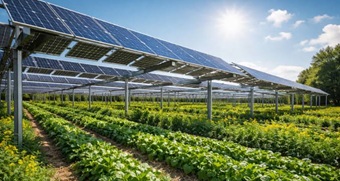
The agrivoltaics market is gaining momentum as agriculture and solar energy increasingly compete for land, water, and investment. Agrivoltaics, also called agri-PV, combines photovoltaic power generation with active farming on the same land. Solar modules can be installed above crops, between agricultural rows, over vineyards and orchards, or alongside livestock grazing areas.
The concept is becoming increasingly relevant as global solar deployment accelerates. Worldwide photovoltaic capacity reached approximately 2.96 TW by the end of 2025, following around 690 GW of new installations during the year. This rapid expansion is intensifying interest in solar configurations that minimize land-use conflicts.
Agrivoltaics Addresses Growing Competition for Land
One of the strongest agrivoltaics market trends is the transition from single-purpose solar farms toward dual-use energy systems. Instead of removing agricultural land from production, an agrivoltaic installation can generate electricity while maintaining crop cultivation or livestock farming.
The potential is significant. Research from the European Commission's Joint Research Centre estimated that deploying agrivoltaics on just 1% of the EU's utilized agricultural area could provide approximately 944 GWDC of installed solar capacity.
This makes agrivoltaics particularly attractive in regions where agricultural land is expensive, scarce, protected, or politically sensitive.
Climate-Resilient Farming Strengthens Agrivoltaics Demand
Agrivoltaics is also attracting attention as a climate-adaptation technology. Solar panels create partial shade that changes conditions underneath the array, potentially affecting soil temperature, crop temperature, evapotranspiration, moisture retention, and exposure to extreme heat. These characteristics are becoming more important as agricultural regions experience hotter growing seasons and periods of water stress.
Crop response, however, varies considerably. Research demonstrates why future agrivoltaic systems must be designed around specific crops and climates rather than standardized PV layouts. A 2026 study found that rice yields remained stable under 27% shading, while soybean and sweet potato experienced larger yield reductions under tested conditions.
The emerging commercial model therefore focuses on finding the optimum balance between crop productivity and electricity generation.
Advanced Agrivoltaic Systems Are Changing Solar Farm Design
Agrivoltaics is evolving far beyond conventional ground-mounted panels. Elevated solar structures can provide sufficient clearance for tractors and harvesting machinery. Vertical bifacial panels can occupy narrow strips between crop rows. Solar trackers can change panel angles throughout the day, while semi-transparent modules offer opportunities for greenhouses and protected agriculture.
Bifacial technology is particularly important. As of 2023, bifacial modules represented more than 75% of global PV module production. Because these modules generate electricity from both surfaces, they provide additional design flexibility for vertical and elevated agrivoltaic installations.
The next stage is smart agrivoltaics. Sensors can monitor soil moisture, temperature, sunlight, weather, and plant conditions, while automated tracking systems adjust panel positions according to crop and electricity-production requirements.
Water Management Creates New Opportunities
Water scarcity could become another major agrivoltaics market driver. Partial shading can reduce direct solar exposure and potentially lower water stress under suitable conditions. Research in a semi-arid Colorado grassland found that although photovoltaic panels reduced available light by 38%, aboveground net primary productivity declined by only around 6–7%. Such findings make agrivoltaics especially interesting for drought-prone agricultural areas across Southern Europe, the Middle East, Africa, Australia, India, and the Americas.
Combining solar arrays with precision irrigation could further improve resource efficiency. Solar electricity generated on-site can power irrigation pumps, monitoring equipment, refrigeration, and other agricultural infrastructure.
Government Policies Are Supporting Agrivoltaics Expansion
Policy frameworks are beginning to distinguish genuine agrivoltaics from conventional solar farms located on agricultural land. European markets are developing requirements related to agricultural productivity, module coverage, structural design, and monitoring. Catalonia, for example, has introduced guidelines requiring agrivoltaic installations to maintain at least 60% of pre-installation crop yield. Italy has also established support for advanced agrivoltaic installations, including systems that monitor agricultural activity, microclimate, water savings, soil fertility, and crop productivity.
This regulatory direction is important. Future projects will increasingly need to demonstrate measurable agricultural value rather than simply maintaining nominal farming activity around solar panels.
Farmers Are Becoming Renewable Energy Producers
Agrivoltaics can also diversify farm economics. Agricultural income is vulnerable to weather, commodity prices, fertilizer costs, water availability, and variable harvests. Solar power can introduce additional revenue through electricity sales, land leases, power purchase agreements, or farmer participation in renewable-energy projects. Battery storage could strengthen this model further. Farms can store excess solar electricity and use it for irrigation, refrigeration, processing, ventilation, lighting, and other operations when required.
Final Thoughts
The agrivoltaics market is shifting from demonstration projects toward integrated agricultural-energy infrastructure. Future growth will increasingly depend on crop-specific system design, bifacial modules, intelligent solar trackers, precision irrigation, sensors, AI-based agricultural monitoring, and battery storage.
The central advantage is land productivity. Instead of forcing policymakers and landowners to choose between food and renewable energy production, agrivoltaics creates an opportunity to generate both from the same site.
As global solar capacity continues expanding and climate pressures on agriculture intensify, agrivoltaics is positioned to become an increasingly important part of sustainable farming and renewable-energy development.
Market Publishers boasts a rich collection of insightful research studies covering various sectors of the agrivoltaics market. Simply use the search form to find the report you need.
CONTACTS
The Market Publishers, Ltd.
Natalie Aster
Tel: +357 96 030 922
[email protected]
MarketPublishers.com
Analytics & News