Top 5 Technology Trends Transforming the Waste-to-Energy Industry
24 Aug 2026 • by Natalie Aster
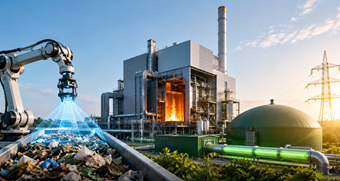
The waste-to-energy industry is entering a new phase. It is no longer defined only by incineration plants converting municipal solid waste into electricity. The sector is becoming a technology-driven platform for landfill diversion, renewable heat, biomethane production, carbon reduction, materials recovery, and circular urban infrastructure.
The pressure behind this transformation is measurable. The world generated about 2.6 billion tonnes of municipal solid waste in 2022, and annual waste generation could rise by 50% by 2050 without stronger policy, investment, and treatment systems. That creates a direct opening for modern waste-to-energy technologies that can handle residual waste after recycling, recover energy from organic streams, and reduce methane leakage from landfills.
The global waste-to-energy market value crossed USD 41.4 billion in 2025, and is projected to rise to USD 55.3 billion by the year 2033. The market is shaped primarily by advances in incineration efficiency, gasification, anaerobic digestion, emission control, and AI-based combustion optimization.
1. AI-Powered Waste Sorting Is Improving Feedstock Quality
One of the biggest changes in waste-to-energy is happening before waste reaches the furnace, digester, or gasifier. Artificial intelligence, machine vision, near-infrared sensors, and robotic sorting systems are improving the quality of feedstock by separating recyclables, organics, metals, plastics, and high-calorific fractions more accurately.
This trend matters because mixed waste is unpredictable. Poor feedstock quality reduces plant efficiency, increases emissions-control costs, and lowers the value of recovered energy. AI sorting helps facilities remove recyclable materials before thermal treatment and direct organic waste toward anaerobic digestion or composting. Recent research on AI-driven municipal solid waste sortation shows that better sorting can improve downstream waste valorization and lower the environmental burden of some recovered waste streams.
2. Advanced Thermal Technologies Are Moving Beyond Traditional Incineration
Modern thermal waste-to-energy plants are becoming cleaner, more controlled, and more specialized. Traditional mass-burn incineration remains the dominant technology for residual municipal waste, but gasification and pyrolysis are gaining attention for specific waste streams where controlled conversion can produce syngas, oils, char, heat, or electricity.
Gasification is especially relevant for prepared waste-derived fuels, industrial waste, biomass residues, and high-calorific fractions. Instead of simply burning waste in excess oxygen, gasification converts carbon-rich material under limited oxygen conditions. This allows operators to recover syngas for heat, power, or further processing. Pyrolysis follows a different pathway by thermally decomposing waste in the absence of oxygen, making it useful in selected plastics, tires, biomass, and specialty waste applications.
The commercial challenge is consistency. These technologies perform best when feedstock is well prepared, moisture is controlled, and contaminants are removed. That is why AI sorting, pre-treatment, and digital process control are becoming essential partners to advanced thermal systems.
3. Anaerobic Digestion Is Turning Organic Waste into Biomethane
Food waste, agricultural residues, sewage sludge, and other wet organic streams are poor candidates for direct incineration because moisture lowers energy efficiency. Anaerobic digestion offers a better route: microorganisms break down organic matter without oxygen, producing biogas that can be used for power, heat, or upgraded into biomethane.
The International Energy Agency highlights biogas and biomethane as locally produced fuels made from organic waste, with benefits for energy security, waste management, emissions reduction, and agriculture. The IEA’s 2025 outlook also notes that policy momentum has increased, with more than 50 new biogas-related policies introduced globally since its earlier landmark report in 2020.
4. Carbon Capture Is Becoming the Next Upgrade for Waste Incineration
Waste-to-energy plants produce both fossil CO₂ from plastics and biogenic CO₂ from paper, wood, food residues, and other organic materials. This makes carbon capture one of the most important next-generation technologies for the sector. When paired with permanent geological storage, carbon capture can reduce fossil emissions and potentially create carbon-negative outcomes from biogenic fractions.
Oslo’s Klemetsrud waste-to-energy plant is one of the clearest examples of this shift. In January 2025, Hafslund Celsio made a final investment decision to establish carbon capture at the Klemetsrud facility, and SLB Capturi with Aker Solutions was awarded a contract to deliver the carbon capture solution. The plant has capacity to treat around 350,000 tonnes of waste per year.
For the global waste-to-energy industry, this is a strategic signal. Future plants will not be judged only by how much waste they process or electricity they export. They will increasingly be judged by their carbon intensity, captured emissions, heat integration, ash handling, and compatibility with climate policy.
5. Digital Emissions Control Is Raising Environmental Performance
Air pollution control has become a decisive technology battleground in waste-to-energy. Modern plants rely on continuous emissions monitoring, advanced flue gas cleaning, selective catalytic reduction, activated carbon injection, baghouse filters, acid gas scrubbers, and automated combustion control. Digital systems now adjust air flow, temperature, residence time, and waste feed rates in real time to stabilize combustion and reduce pollutant formation.
This trend is essential for public acceptance. Waste-to-energy projects can only expand where communities trust the technology, regulators enforce strict limits, and operators prove consistent environmental performance. The best facilities are evolving into transparent, data-rich infrastructure assets that report emissions, recover heat, extract metals from bottom ash, and reduce landfill dependence.
Waste-to-Energy Outlook: Smarter, Cleaner & More Integrated
The future of waste-to-energy will not be built around a single technology. The strongest projects will combine front-end sorting, recycling recovery, anaerobic digestion for organics, high-efficiency thermal treatment for residual waste, district heating integration, advanced flue gas cleaning, and carbon capture where economics and infrastructure allow.
As cities face rising waste volumes, land constraints, methane concerns, and pressure to decarbonize energy systems, waste-to-energy is becoming more than a disposal option. It is becoming a flexible urban infrastructure platform. The winners will be the technologies that recover more value from waste while sending less material to landfill, emitting less carbon, and producing cleaner power, heat, gas, and recovered materials.
At Market Publishers you’ll find a rich collection of insightful research studies featuring various markets. Simply use the search form to find the report you need.
CONTACTS
The Market Publishers, Ltd.
Natalie Aster
Tel: +357 96 030 922
[email protected]
MarketPublishers.com
Analytics & News