Agricultural Leaders: Top Wheat-Producing Countries
13 Aug 2026 • by Natalie Aster

Wheat remains one of the pillars of the global food system, supplying flour for pasta, bread, noodles, bakery products, animal feed, and a growing range of processed foods. The geography of global wheat production is highly concentrated: a relatively small group of agricultural powers determines a large share of worldwide supply.
According to the USDA Foreign Agricultural Service July 2026 outlook, the world’s wheat production volume for the 2026/27 marketing year is forecast at approximately 819.97 million metric tons. China, India, and Russia alone are expected to produce about 350.5 million metric tons, equivalent to roughly 43% of the global output volume.
Global wheat production by country, 2026
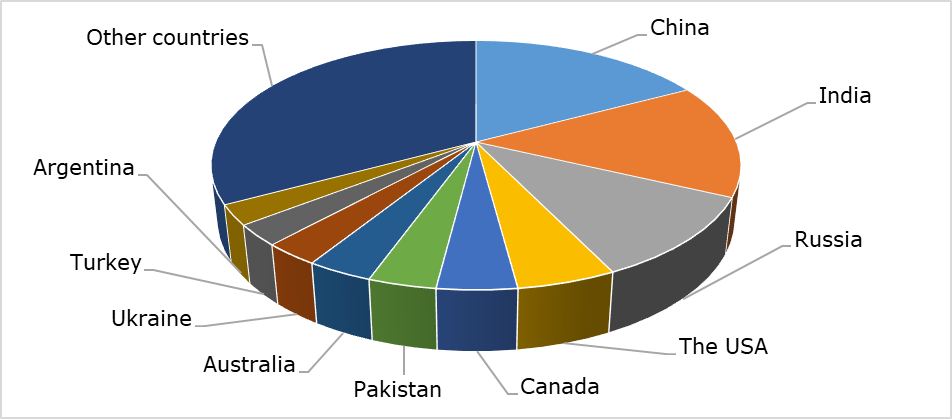
Source: USDA Foreign Agricultural Service, July 2026.
(The European Union is excluded because it represents a regional bloc rather than an individual country).
China Maintains Its Position as the World's Dominant Wheat Producer
With projected wheat output of 141 million metric tons, China remains the largest wheat producer. The country accounts for more than 17% of projected global output.
China's enormous domestic food market absorbs most of this production. USDA forecasts Chinese wheat consumption at approximately 148 million metric tons in 2026/27, demonstrating why the country can simultaneously be the world's largest producer and still participate in international wheat imports.
India Strengthens Its Role in Global Wheat Production
India ranks second with projected output of around 121 million metric tons, a substantial upturn from 113.3 million metric tons in 2024/25. Wheat is central to northern and central Indian agriculture, with Uttar Pradesh, Madhya Pradesh, Punjab, Haryana, and Rajasthan forming the core production belt.
India's scale is particularly important for global food security. USDA projects wheat consumption of about 111.4 million metric tons in 2026/27, meaning changes in Indian harvest conditions, government procurement, inventories, or trade policy can quickly influence expectations across international grain markets.
Russia Remains a Wheat Production & Export Powerhouse
Russia occupies third place among wheat producers, with its 2026/27 wheat crop forecast at 88.5 million metric tons. The July USDA estimate was increased from 88 million metric tons as prospects for the Russian crop improved.
Russia's influence extends well beyond production volume because a large proportion of its wheat enters international trade. USDA raised its 2026/27 Russian wheat export forecast by 500,000 metric tons in July, reflecting increased production expectations.
The United States & Canada Lead High-Value Wheat Production
The United States ranks fourth among leading wheat producers with the output volume of approximately 41.8 million metric tons, while Canada follows with 34 million metric tons. Production volume tells only part of their importance: both countries supply internationally traded wheat classes valued for milling quality and protein characteristics.
USDA lowered its July 2026/27 production forecasts for both countries, citing smaller crops, while U.S. wheat export prices remained among the highest of major exporters. In early July, U.S. Hard Red Winter wheat was quoted around USD 295 per metric ton, compared with approximately USD 227 for Russian and Argentine wheat.
Pakistan, Australia, Ukraine, Turkey & Argentina Complete the Top Ten
The next group illustrates how geographically diverse global wheat cultivation has become. Pakistan is forecast to harvest 29 million metric tons, narrowly ahead of Australia's 28 million. Ukraine is set to produce 24 million metric tons, while Turkey reaches 22.5 million and Argentina approximately 21 million.
Australia, Ukraine, and Argentina are especially significant to international wheat availability because their exportable surpluses can be large relative to domestic consumption. Ukraine's July production forecast was increased from 23.5 million to 24 million metric tons, while its export forecast was also raised by 500,000 metric tons.
Global Wheat Production Outlook: Concentrated Supply, Global Consequences
The ten largest wheat-producing countries are slated to harvest almost 551 million metric tons in 2026/27, representing about 67% of worldwide wheat production. That concentration explains why drought, excessive rainfall, heat waves, export restrictions, currency movements, or logistics disruptions in only a few agricultural regions can reshape international wheat prices.
The broader market is entering 2026/27 after an exceptionally large 2025/26 harvest. USDA estimates the previous season's global crop at approximately 843.8 million metric tons, while the July 2026 forecast places the new crop near 820 million metric tons, around 3% lower YoY.
China and India dominate production through enormous domestic agricultural systems; Russia combines massive production with export strength; and the United States, Canada, Australia, Ukraine, and Argentina remain crucial suppliers to international buyers. Together, these top wheat-producing countries will continue to shape global grain availability, food prices, trade flows, and agricultural market conditions throughout 2026/27.
Related Reports:
- Global Wheat Market - 2025-2033
- CIS Countries: Wheat Market
- Gluten, wheat Market Research Report 2026
- Global Rolled Feed Wheat Market Growth 2026-2032
- The Global Cereal Flours Market - Analysis, Size, Trends, Consumption, and Forecast
- Global Wheat Starch Market 2026 by Manufacturers, Regions, Type and Application, Forecast to 2032
- Global Wheat Seeds Supply, Demand and Key Producers, 2026-2032
At Market Publishers you’ll find a rich collection of insightful research studies featuring various markets. Simply use the search form to find the report you need.
CONTACTS
The Market Publishers, Ltd.
Natalie Aster
Tel: +357 96 030 922
[email protected]
MarketPublishers.com
Analytics & News