Agricultural Leaders: Top 5 Lemon & Limes Producing Countries
02 Jun 2026 • by Natalie Aster

Lemons are no longer just a fresh-produce staple used in kitchens, beverages and foodservice. They are a high-value agricultural commodity tied to global trade, juice processing, essential oils, citric acid production, pharmaceutical ingredients, cosmetics, and functional food trends. As demand rises for natural flavoring, vitamin-rich produce and clean-label ingredients, lemon-producing countries are strengthening their orchards, export chains and processing capacity. Today, the global lemon and lime market is being shaped by three forces: resilient demand for fresh citrus, stronger industrial use of lemon juice and essential oils, and weather-related pressure in several Mediterranean producing regions.
The global lemon and lime sector remains concentrated among a handful of agricultural leaders. In the 2025/2026 production season, the global output volume reaches around 23 million metric tons, exhibiting a slight YoY decline.
The latest estimates show that global fresh lemon and lime production remains concentrated in a small group of agricultural leaders. The ranking below highlights the top five producing-countries shaping global lemon supply.
Global lemon production by country, 2025/2026
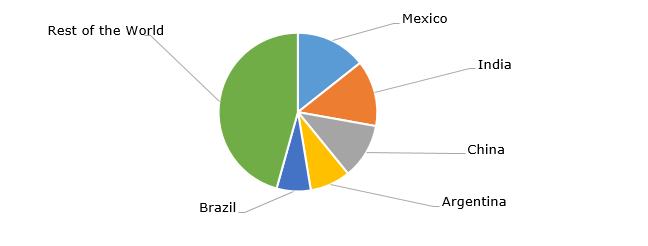
Mexico: The Leading Lemon and Lime Producer in 2025/2026
Mexico is projected to produce approximately 3.3 million metric tons of lemons and limes in 2025/2026, keeping the country at the center of global citrus supply. Its strength comes from a powerful combination of acreage, climate, export logistics and year-round demand from nearby North American markets.
The Mexican lemon and lime industry is anchored by key producing regions such as Veracruz, Michoacán, Colima and Oaxaca. These regions support large volumes of Persian limes, key limes and lemons for both domestic consumption and export channels. Mexico’s proximity to the United States gives it a major competitive advantage, especially for fresh limes used by retailers, restaurants, beverage companies and foodservice operators.
While some citrus categories in Mexico are expected to face slight seasonal pressure, lemons and limes remain one of the more resilient segments. Expanding acreage and steady international demand continue to support Mexico’s position as a global citrus leader.
India: A Domestic Giant in Lemon Production
India remains one of the world’s largest lemon-producing countries, with 2025/2026 output estimated at around 3.0–3.2 million metric tons. Unlike Mexico, India’s strength is not built mainly on exports. Its lemon industry is supported by a massive domestic market where lemons are used daily in cooking, beverages, pickles, traditional remedies, street food, packaged drinks and household applications.
Production is spread across several major citrus-growing states, including Andhra Pradesh, Gujarat, Maharashtra, Telangana and Karnataka. This wide geographic base gives India resilience, although yields can vary depending on monsoon patterns, irrigation access and local growing conditions.
India’s lemon sector has strong long-term growth potential. Better cold-chain infrastructure, improved post-harvest handling and larger processing capacity could help the country convert more of its huge production base into higher-value products such as lemon juice, concentrates, extracts and packaged citrus beverages.
China: A Major Asian Lemon Producer
China is estimated to produce around 2.6–2.7 million metric tons of lemons and limes in 2025/2026, maintaining its place among the top global producers. The Chinese lemon sector benefits from large-scale fruit cultivation, rising consumer demand and expanding use of citrus in tea drinks, flavored water, desserts, sauces and health-focused beverages.
Sichuan is one of China’s most important lemon-growing areas, with production supported by suitable climate conditions and improving agricultural techniques. China’s citrus market is strongly domestic, and its lemon demand is closely connected to the growth of ready-to-drink tea, fresh fruit beverages and wellness-oriented consumption.
China’s position is especially important because it combines production volume with a huge consumer base. Even without dominating global fresh lemon exports, China remains one of the core countries shaping worldwide lemon and lime supply.
Argentina: The Global Center of Lemon Processing
Argentina’s lemon production for 2025/2026 is projected at nearly 1.9 million metric tons, keeping the country among the most important lemon producers in the world. Its influence is much larger than fresh volume alone suggests because Argentina is a global leader in lemon processing.
The province of Tucumán is the heart of Argentina’s lemon economy. A large share of the crop is processed into lemon juice concentrate, essential oil, dehydrated peel and other industrial ingredients. These products are critical for beverage manufacturers, food processors, cosmetics companies, flavor producers and pharmaceutical suppliers.
Argentina’s lemon sector is highly export-oriented in processed form. Its competitive advantage lies in industrial scale, technical expertise and the ability to supply standardized lemon derivatives to international B2B markets.
Brazil: A Strong Citrus Producer with Lemon & Lime Growth Potential
Brazil is estimated to produce around 1.6 million metric tons of lemons and limes in 2025/2026, supported by its broader position as one of the world’s great citrus-growing nations. Although Brazil is best known for oranges and orange juice, its lemon and lime sector remains important for fresh consumption, foodservice, beverages and regional trade.
Brazil benefits from warm growing conditions, experienced citrus farmers and strong agricultural logistics. Its lime production is particularly relevant for domestic use and export opportunities, especially as global demand for tropical citrus flavors continues to expand.
The country’s long-term opportunity lies in value-added citrus development. With its farming scale and processing knowledge, Brazil can strengthen its position in lemon-based ingredients, fresh lime exports and citrus derivatives for food and beverage applications.
2025/2026 Market Insight: Production Power Is Shifting Toward the Americas
The 2025/2026 season highlights a clear market pattern: the Americas are gaining importance in global lemon and lime supply. Mexico is expanding its role in fresh production, Argentina remains stable in processed lemons, and Brazil continues to provide scale. At the same time, lower yields in parts of the European Union and Turkey are expected to reduce global fresh lemon/lime production.
This makes supply reliability more important than simple acreage. Countries with strong irrigation, disease management, packing facilities, export logistics and processing capacity are better positioned to serve international buyers when weather weakens competing regions.
Conclusion: The Future of Lemon Production Belongs to High-Value Citrus Economies
The top five lemon producing countries in 2025/2026 – Mexico, India, China, Argentina and Brazil – represent different models of agricultural leadership. Mexico leads through export-ready volume, India through domestic scale, China through consumer demand, Argentina through processing specialization, and Brazil through citrus farming depth.
As demand grows for natural flavors, vitamin-rich foods, citrus beverages, clean-label ingredients and essential oils, lemon-producing countries will compete not only by harvest size but by quality, consistency, processing capacity and trade reliability. The leaders of the next decade will be the countries that can turn raw citrus production into high-value global supply chains.
At Market Publishers you’ll find a rich collection of insightful research studies featuring various markets. Simply use the search form to find the report you need.
CONTACTS
The Market Publishers, Ltd.
Natalie Aster
Tel: +357 96 030 922
[email protected]
MarketPublishers.com
Analytics & News