From Ban to Boom: The Resilient Story of the Global Methyl Tertiary Butyl Ether Market
30 Jun 2025 • by Natalie Aster

The world’s market for Methyl Tertiary Butyl Ether (MTBE) has undergone a transformative journey marked by intense regulatory scrutiny, environmental controversy, and remarkable market adaptation. Once condemned as an environmental hazard, MTBE has reemerged as a strategic chemical additive, especially in regions where fuel quality enhancement remains critical.
What is Methyl Tertiary Butyl Ether (MTBE)?
MTBE is a high-octane additive blended with gasoline to reduce engine knocking and improve fuel combustion. Produced by the chemical reaction of isobutylene with methanol, MTBE gained widespread adoption in the 1980s and 1990s as a cleaner-burning oxygenate, replacing lead in gasoline. However, concerns over groundwater contamination led to sweeping bans in the United States and several European countries.
Regulatory Backlash: The Fall of MTBE in the West
By the early 2000s, MTBE was under siege. The U.S. Environmental Protection Agency (EPA) flagged its solubility in water and resistance to biodegradation as major concerns, with numerous states enacting bans due to detected contamination of drinking water supplies. California and New York led the way, banning MTBE in 2004, with many others following suit.
This resulted in a sharp contraction of the North American and European MTBE markets, pushing refiners to adopt ethanol as the preferred oxygenate. However, while the West turned its back on MTBE, the East saw a strategic opportunity.
MTBE Market Rebounds in Asia-Pacific and the Middle East
As Western markets retreated, Asia-Pacific and the Middle East stepped into the vacuum. Countries like China, Saudi Arabia, and Iran rapidly expanded MTBE production and consumption, leveraging the compound’s cost-effectiveness and compatibility with existing refinery infrastructure.
China: The Global Powerhouse of MTBE
China has emerged as the world’s largest MTBE consumer and producer, accounting for over 40% of global demand. Driven by rising automotive fuel consumption, the Chinese refining sector relies heavily on MTBE to meet stringent fuel octane standards. Government policies that aim to cut vehicle emissions, without mandating ethanol blending, have created a favorable environment for MTBE.
Middle East: Leveraging Feedstock Abundance
With easy access to methanol and isobutylene feedstocks, Gulf nations have positioned themselves as key MTBE exporters. Saudi Arabia and Iran, in particular, have scaled up production to cater to Asian markets, reinforcing their influence in the global petrochemicals value chain.
Why MTBE Is Making a Comeback Globally
Despite its earlier ban in parts of the world, MTBE is experiencing a second wind due to the following strategic advantages:
- Superior blending performance compared to ethanol.
- Non-hygroscopic nature, preventing water absorption and corrosion issues.
- Lower volatility, which improves fuel stability in high-temperature regions.
- Cost-effectiveness and compatibility with existing fuel logistics.
These properties make MTBE a preferred choice in countries where ethanol infrastructure is underdeveloped or where climate conditions discourage ethanol use.
As of 2025, the global MTBE market is estimated to exceed USD 15 billion, with an anticipated CAGR of 4.5% from 2024 to 2030. The primary demand drivers include surging automotive fuel demand in developing nations, refinery modernization programs in Asia and the Middle East, and increased octane requirements in regional fuel quality standards.
Global petrochemical giants are actively investing in MTBE capacity expansions, particularly in regions with growing vehicle fleets and limited ethanol availability. For instance, SABIC is expanding capacity in Al-Jubail to serve Southeast Asian demand. Sinopec is building new units in inland China to meet domestic and export needs. Russian refiners are focusing on Central Asia and Eastern Europe for MTBE export markets.
Despite its resurgence, the MTBE market faces several headwinds, to name a few: continued regulatory scrutiny in Western regions, competition from bio-based fuel additives as green energy goals intensify, volatility in methanol prices, which directly impacts MTBE profitability. However, with smart positioning, technological innovation, and regional focus, MTBE producers are well-equipped to navigate the evolving energy landscape.
MTBE vs Ethanol: A Strategic Comparison
While ethanol remains dominant in North America, MTBE retains a technological edge in several key aspects:
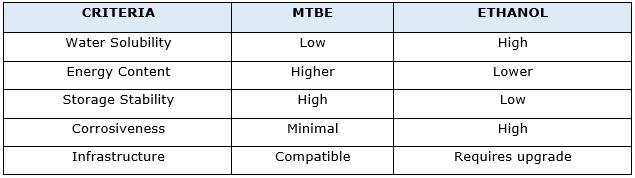
For countries with limited ethanol production, challenging climates, or legacy refining systems, MTBE presents a compelling alternative. Countries like India, Brazil (non-ethanol regions), Indonesia, and Pakistan are witnessing increased MTBE usage to address fuel efficiency without heavy investment in ethanol blending systems. MTBE helps meet Euro VI-equivalent fuel standards, which many emerging markets are adopting to combat urban air pollution.
Environmental Concerns: Are They Still Valid?
While MTBE’s contamination risks remain valid, new containment technologies, stricter leakage monitoring, and closed-loop handling systems have significantly reduced the risk of environmental exposure in compliant regions. Unlike the 1990s, today’s MTBE market functions within more sophisticated regulatory and operational frameworks.
Final Thoughts: The MTBE Market Has Evolved, Not Disappeared
From being the poster child of fuel additive controversy to becoming an indispensable octane booster in the East, MTBE has demonstrated remarkable market resilience. It’s not just a story of chemical revival – it’s a case study in regional adaptation, strategic supply chain realignment, and technological maturity. As the global energy ecosystem continues to evolve, MTBE is no longer a banned substance, but a booming commodity in the right markets.
Report Details:
Methyl Tertiary Butyl Ether (MTBE): 2025 World Market Outlook and Forecast up to 2034
Published: June 2025
Pages: 192
Market Publishers boasts a rich collection of insightful research studies covering the chemicals and petrochemicals market, find it in the Methyl Tertiary Butyl Ether Market Research Reports Catalogue.
CONTACTS
The Market Publishers, Ltd.
Natalie Aster
Tel: +357 96 030 922
[email protected]
MarketPublishers.com
Analytics & News