
Sustainability & Green Chemistry: Future Pathways for Tertiary Butyl Alcohol
10 Feb 2026 • by Natalie Aster
Tertiary Butyl Alcohol (TBA) is entering a new era shaped by sustainability expectations, environmental regulations, and the accelerating global commitment to green chemistry. As industries restructure supply chains around low-carbon raw materials and environmentally responsible practices, TBA stands out as an essential intermediate whose future will be defined by how efficiently and cleanly it can be produced. From fuel additives and coatings to pharmaceuticals and performance chemicals, its applications are expanding in parallel with an intensified focus on renewable feedstocks and energy-efficient synthesis.
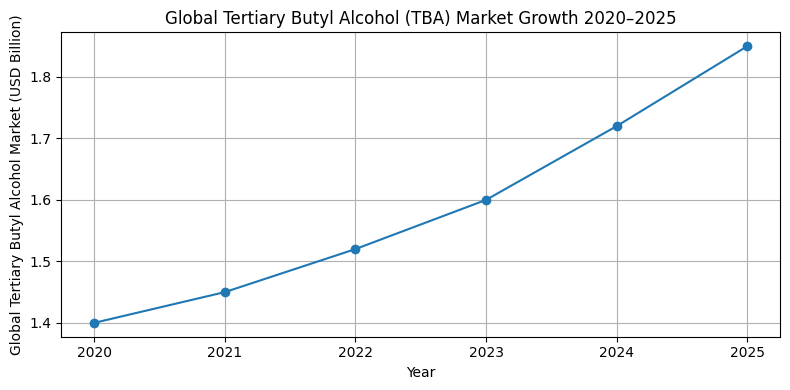
The global TBA market continues to grow steadily, supported by rising consumption across fuel oxygenates and solvent applications. The trend is reinforced by increasingly strict environmental standards, which push companies to adopt greener production technologies. The chart below shows the recent TBA market growth trajectory, underscoring how TBA’s economic relevance is deepening as sustainability becomes a competitive advantage.
Green Chemistry as the Engine of TBA's Transformation
The principles of green chemistry are becoming the structural foundation of modern TBA production. Traditional synthesis relies heavily on fossil-derived isobutylene, but emerging pathways now allow producers to break away from this dependency. Bio-isobutylene derived from biomass, fermentation-based hydrocarbons produced from industrial waste gases, and algae-generated feedstocks create new opportunities for manufacturers to significantly reduce the carbon intensity of TBA. These renewable sources do more than lower emissions; they provide supply stability in an increasingly volatile petrochemical landscape.
Beyond raw materials, the production process itself is undergoing a remarkable evolution. Modern catalyst technologies allow reactions to proceed at lower temperatures, which reduces energy use and minimizes harmful by-products. Many plants are transitioning to closed-loop water systems that dramatically decrease freshwater consumption while improving wastewater quality. Process intensification (particularly through microreactor systems and advanced distillation) has been shown to increase energy efficiency by more than 25%, while improved emission controls help facilities cut volatile organic compound releases substantially. Collectively, these innovations are redefining what “clean chemistry” looks like for TBA.
Circular Economy Principles Redefining TBA Value Chains
Sustainability has grown beyond cleaner production to encompass the entire life cycle of chemicals, and TBA is no exception. Circularity is becoming a central operating philosophy in advanced facilities, where waste streams are increasingly viewed as valuable inputs rather than disposal liabilities. The recovery of TBA from solvent applications has become highly efficient, with modern systems capable of recapturing the vast majority of the material for reuse. This considerably reduces both environmental impact and operational costs.
Equally noteworthy is the rise of technologies that convert by-products and residues back into upstream feedstocks, effectively closing the loop and extending the life of each molecule. Even wastewater streams are being transformed through biological treatment systems, where engineered microorganisms degrade TBA more effectively than conventional processes. These innovations reveal a broader shift toward a chemical economy in which waste reduction and resource regeneration are just as important as product output.
Sustainable Growth Across Major Application Segments
The industries that rely on TBA are themselves transforming, and this has a direct influence on market direction. Fuel additives remain a key outlet, particularly ETBE made from bioethanol, which offers significantly lower lifecycle carbon emissions compared to traditional petroleum-based alternatives. The emphasis on cleaner fuels in Europe, Japan, and parts of North America is pushing ETBE and other oxygenates toward wider adoption.
In the coatings and resin sectors, regulatory restrictions on volatile organic compounds have accelerated the transition to low-emission formulations. TBA derivatives are proving essential in creating coatings that meet both performance expectations and environmental standards. In pharmaceuticals and cosmetics, the shift toward safer and more biodegradable processing materials means green solvent alternatives, many of which are TBA-derived, are becoming indispensable.
A Forward-Looking Vision for Sustainable TBA
The pathway ahead for tertiary butyl alcohol is defined by regulatory momentum, corporate sustainability commitments, and technological innovation. The next decade is expected to bring an even stronger push toward bio-based TBA, powered by continued advancements in fermentation engineering and renewable feedstock integration. Artificial intelligence is beginning to influence process optimization, guiding manufacturers toward energy-efficient pathways that reduce costs and emissions simultaneously.
Hydrogen-based chemical routes and modular carbon capture systems are also entering the conversation as companies aim for near-zero-emission production models. The growing adoption of circular solvent management systems in paint, adhesive, and electronics manufacturing underscores how TBA will benefit from broader industrial decarbonization strategies.
Final Thoughts: The Future of Tertiary Butyl Alcohol Is Green, Circular & High-Value
Tertiary Butyl Alcohol is positioned at a pivotal moment where sustainability is no longer an option but a strategic imperative. The combination of renewable feedstock innovation, cleaner processing technologies, and circular economy integration is steering the industry toward a more responsible and more resilient future. Companies that modernize their TBA value chains today will be the ones best equipped to meet the demands of tomorrow’s low-carbon global economy.
Related Reports:
- TERT-BUTYL ALCOHOL (CAS 75-65-0) Market Research Report 2026
- Tert-butyl alcohol (CAS 76-65-0) Market Research Report 2026
- Tertiary Butyl Alcohol Market -Global Industry Size, Share, Trends, Opportunity, and Forecast Segmented By Type (Industrial Grade and Reagent Grade), By End User Industry (Chemicals, Pharmaceuticals, Cosmetics and Personal Care, Food and Beverage, and Others (Automotive, Paints and Coatings)), By Sales Channel (Direct Sales and Indirect Sales), By Region and Competition, 2020-2030F
- Global Tert-butyl Alcohol (TBA) Market Growth 2025-2031
- Global Tert-butyl Alcohol (TBA) Market Research Report 2025(Status and Outlook)
Market Publishers boasts a rich collection of insightful research studies covering the chemicals and petrochemicals market, find it in the Monohydric Alcohols Market Reports Catalogue.
CONTACTS
The Market Publishers, Ltd.
Natalie Aster
Tel: +357 96 030 922
[email protected]
MarketPublishers.com
Analytics & News
29 Oct 2026
Where Is the Diagnostics Market Heading? 10 Promising Sectors to Watch
26 Oct 2026
Weekly Chemical Market Tracker: Update for October 19-26, 2026
23 Oct 2026
Military Aviation Market: Recent Developments Shaping 2026
21 Oct 2026
New Era of Cryptocurrency: The Rise of Regulated Digital Finance
19 Oct 2026
Weekly Chemical Market Tracker: Update for October 12–19, 2026
