
Methyl Ethyl Ketone: A Go-To Solvent for Specialty Chemicals
21 Aug 2025 • by Natalie Aster

Methyl Ethyl Ketone (MEK), aka butanone, has become one of the most widely used solvents in the specialty chemicals industry. Its unique combination of evaporation rate, solvency power, and compatibility with a broad spectrum of substances makes it indispensable across coatings, inks, adhesives, and chemical synthesis. With global demand for high-performance solvents on the rise, MEK continues to be at the center of innovation and industrial growth.
Rising Importance of MEK in the Specialty Chemicals
The value of the world’s market for methyl ethyl ketone was about USD 3.5 billion last year and is slated to expand at a CAGR of around 5.2% from 2025 to 2030, according to industry reports. Growth is being driven by sectors such as paints and coatings, where MEK’s fast evaporation and excellent solubility profile deliver superior film formation and finish quality.
Industrial transformation in Asia-Pacific, particularly China and India, has made the region the largest consumer of MEK, accounting for nearly 55% of global demand. Meanwhile, North America and Europe continue to emphasize sustainability, prompting innovations in bio-based production methods to minimize dependency on fossil fuel feedstocks.
Chemical Properties That Make MEK a Preferred Solvent
MEK’s value lies in its chemistry. Its moderate boiling point of 79.6°C (175°F) allows it to evaporate quickly without leaving residue, rendering it ideal for fields requiring rapid drying. The solvent is highly effective in dissolving resins, polymers, oils, and gums, giving manufacturers flexibility across multiple formulations.
Compared with acetone, MEK offers superior solvency strength for nitrocellulose, acrylics, and vinyl resins, making it the solvent of choice in specialty coatings and adhesives where performance and durability are critical.
MEK in Coatings, Adhesives, and Inks
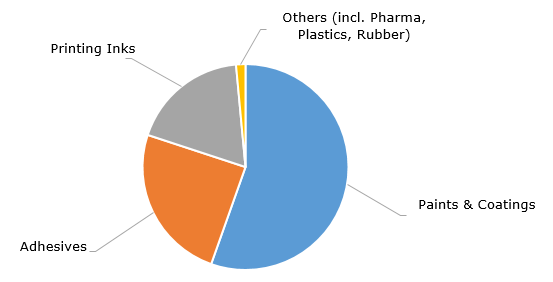
Paints & Coatings: MEK is vital in industrial finishes, automotive coatings, and wood lacquers. Its fast-drying nature enhances production efficiency while ensuring high-gloss, durable finishes.
Adhesives: In synthetic rubber and contact cement adhesives, MEK enhances tack strength and durability, supporting applications in construction and footwear manufacturing.
Printing Inks: The solvent ensures rapid drying, vibrant color adhesion, and smear resistance, particularly for high-speed printing operations.
Structure of the Methyl Ethyl Ketone Market by End-Use
Sustainability and Regulatory Outlook
While MEK remains an industrial staple, environmental regulations are reshaping production and application. MEK is classified as a volatile organic compound (VOC), requiring manufacturers to adopt strict compliance measures in emission controls.
Recent developments include bio-based MEK production derived from renewable materials such as sugarcane ethanol and glycerol, offering a greener alternative for industries aiming to lower their carbon footprint. Companies like Maruzen Petrochemical and Shell Chemicals are investing heavily in sustainable MEK production pathways to align with evolving regulatory frameworks in Europe and North America.
Supply and Demand Trends
The MEK industry has experienced periodic supply constraints due to fluctuations in crude oil derivatives and plant shutdowns. In 2023, global MEK production capacity was estimated at some 2.1 million metric tons, with Asia-Pacific contributing over 60%.
Future supply dynamics are expected to shift as bio-MEK gains traction, supported by strong R&D investments and soaring demand from the eco-friendly adhesives and coatings sectors, which is forecasted to grow by 6.8% annually through 2030.
Outlook: MEK as a Catalyst for Specialty Chemicals Growth
As specialty chemical industries evolve, the role of MEK is poised to remain robust. Its versatility in applications, coupled with new strides in bio-based production technologies, ensures MEK will continue to be a cornerstone solvent well into the next decade.
The shift toward greener, low-VOC formulations will not diminish MEK’s relevance but rather reposition it as part of a sustainable chemicals ecosystem, where innovation meets regulatory compliance.
Final Thoughts
Methyl Ethyl Ketone has established itself as more than just a solvent – it is a performance enabler across coatings, inks, adhesives, and specialty chemical formulations. With a global market on a growth trajectory and increasing investment in sustainable production, MEK remains a go-to choice for manufacturers seeking efficiency, performance, and regulatory alignment. Its future lies in balancing industrial demand with environmental responsibility, making MEK a central player in shaping the next generation of specialty chemicals.
Related Reports:
- Methyl Ethyl Ketone (MEK): 2025 World Market Outlook and Forecast up to 2034
- Global Methyl Ethyl Ketone (MEK) Market 2025 by Manufacturers, Regions, Type and Application, Forecast to 2031
- Global Methyl Ethyl Ketone (MEK) Market Growth 2025-2031
- Global Methyl Ethyl Ketone (MEK) Market Research Report 2024(Status and Outlook)
- Global Methyl Ethyl Ketone (MEK) Competitive Landscape Professional Research Report 2025
- Methyl Ethyl Ketone (MEK) Market Report by Application (Paints and Coatings, Adhesives and Thinners, Printing Inks, Pharmaceuticals, and Others), Form (Liquid Form, Solid Form), Grade (Regular Grade, Urethane Grade, and Others), and Region 2025-2033
Market Publishers boasts a rich collection of insightful research studies covering the chemicals and petrochemicals market, find it in the Chemicals & Petrochemicals Market Reports Catalogue.
CONTACTS
The Market Publishers, Ltd.
Natalie Aster
Tel: +357 96 030 922
[email protected]
MarketPublishers.com
Analytics & News
29 Oct 2026
Where Is the Diagnostics Market Heading? 10 Promising Sectors to Watch
26 Oct 2026
Weekly Chemical Market Tracker: Update for October 19-26, 2026
23 Oct 2026
Military Aviation Market: Recent Developments Shaping 2026
21 Oct 2026
New Era of Cryptocurrency: The Rise of Regulated Digital Finance
19 Oct 2026
Weekly Chemical Market Tracker: Update for October 12–19, 2026
