
Octafluorocyclobutane: From Specialty Gas to Semiconductor Essential
14 Jul 2025 • by Natalie Aster

In the fast-paced world of semiconductor innovation, even the most unassuming elements can become essential. One such example is octafluorocyclobutane (C₄F₈) – a clear, odorless gas that has quietly emerged as a key player in advanced electronics manufacturing. Initially used as a specialty gas, octafluorocyclobutane has now carved out a critical role in the production of today’s most sophisticated chips, particularly as the industry pushes the limits of miniaturization.
The Backbone of Precision Etching in Modern Fabrication
At its core, octafluorocyclobutane is valued for its chemical stability and ability to generate reactive fluorine species when used in plasma environments. This makes it an ideal choice for plasma etching, especially in applications that demand extreme precision, such as the fabrication of microelectromechanical systems (MEMS) and advanced semiconductor nodes.
Its use in deep reactive ion etching (DRIE) processes allows manufacturers to carve incredibly detailed patterns into silicon wafers, forming the microscopic structures that underpin modern integrated circuits. As semiconductors evolve toward more compact and complex designs, such as FinFETs and 3D NAND architectures, the ability of octafluorocyclobutane to deliver clean, high-aspect-ratio etches becomes even more valuable.
Market on the Rise: Growth Fueled by Technology Demands
Global demand for octafluorocyclobutane has been climbing steadily, driven by the booming semiconductor sector. As AI, 5G, electric vehicles, and advanced consumer electronics take center stage, the need for higher-performing chips has never been greater. This, in turn, has heightened the need for high-purity etching gases like octafluorocyclobutane.
In 2020, the global market for octafluorocyclobutane was valued at around USD 290 million. Fast forward to 2025, and that figure is expected to reach USD 445 million, reflecting a robust CAGR of approximately 9.1%.
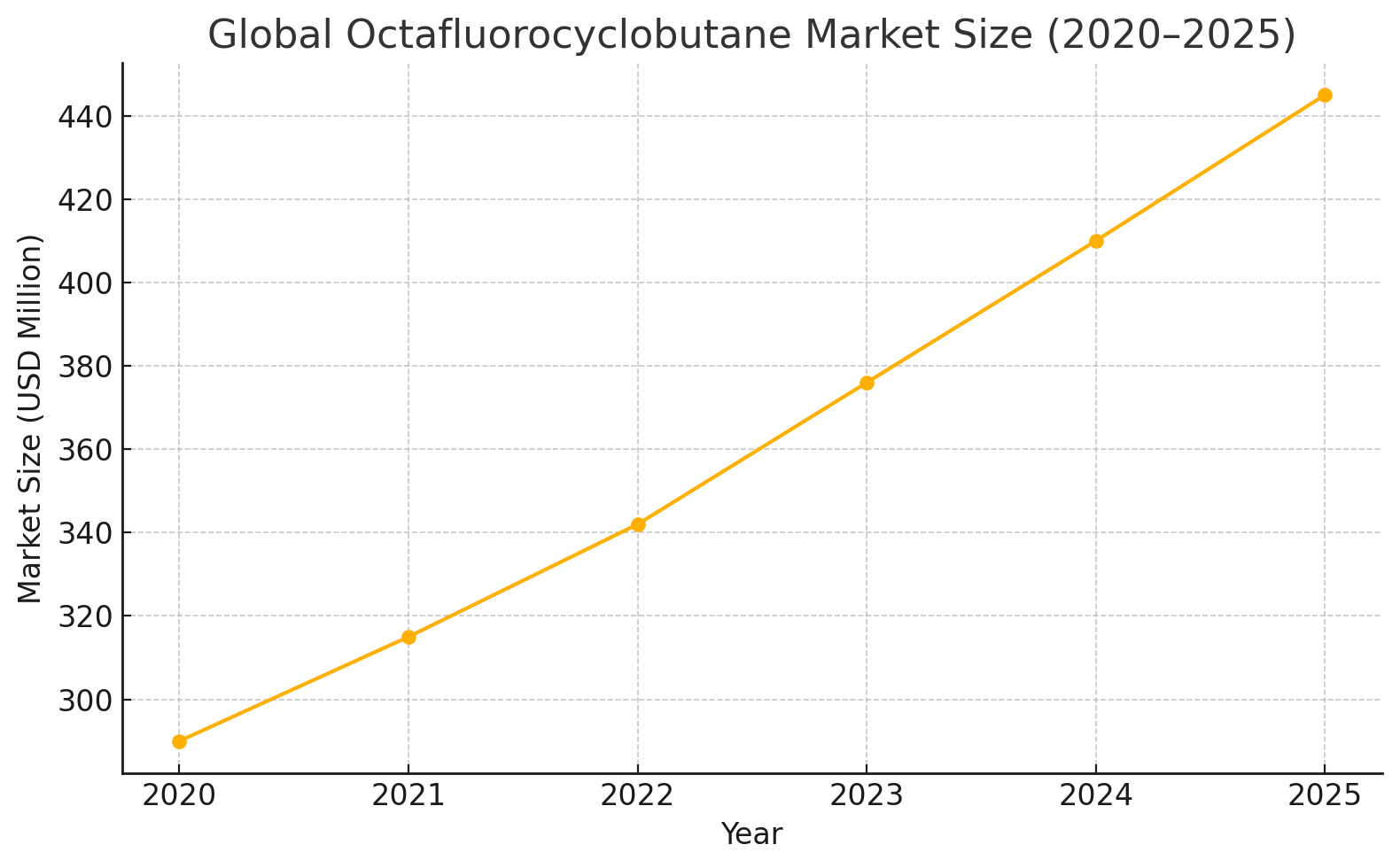
Much of this growth is centered in Asia-Pacific, where semiconductor manufacturing powerhouses like Taiwan, South Korea, and China dominate. However, with large-scale investments happening globally, from the U.S. CHIPS Act to Europe’s semiconductor expansion initiatives, demand is going global.
Balancing Performance with Environmental Responsibility
Despite its industrial advantages, octafluorocyclobutane presents environmental challenges. Classified as a high global warming potential (GWP) gas (nearly 8,700 times more potent than CO₂) it has come under increased regulatory scrutiny. Agencies such as the U.S. Environmental Protection Agency (EPA) and European REACH have begun tightening restrictions around its use, prompting manufacturers to adopt emission control and gas abatement systems.
Yet, octafluorocyclobutane remains difficult to replace. While alternatives like perfluoropropane or nitrogen trifluoride are under exploration, few offer the same level of precision and reliability in advanced plasma etching processes. Its unique ability to support anisotropic etching, essential for creating vertical walls in silicon substrates, keeps it at the forefront of semiconductor manufacturing.
A Technological Edge That’s Hard to Replicate
In the pursuit of ever-smaller and more powerful chips, fabrication processes are evolving rapidly. Octafluorocyclobutane plays a vital role in these advancements. Whether in wafer-level chip-scale packaging, 3D chip stacking, or through-silicon via (TSV) formation, this gas enables manufacturers to push the boundaries of what's possible.
Innovations in gas cycling and etch chemistry, especially when octafluorocyclobutane is combined with compounds like SF₆ or O₂, have significantly improved process control, profile accuracy, and throughput. These refinements make it a mainstay in next-generation chipmaking strategies, from mobile processors to AI accelerators.
Final Thoughts: Small Molecule, Massive Impact
As the semiconductor landscape becomes increasingly competitive and technologically demanding, the importance of specialized materials like octafluorocyclobutane continues to grow. What was once a niche specialty gas is now a foundation for some of the world’s most advanced electronics.
Looking ahead, its trajectory seems tightly bound to that of the broader semiconductor industry, one where innovation is constant, tolerances are tighter, and precision is non-negotiable. While environmental concerns will shape its use, the technological necessity of octafluorocyclobutane ensures it will remain a cornerstone of chip manufacturing for years to come.
Related Reports:
- Octafluorocyclobutane Market Research Report 2025
- OCTAFLUOROCYCLOBUTANE (CAS 115-25-3) Market Research Report 2025
- Global Octafluorocyclobutane Market 2025 by Manufacturers, Regions, Type and Application, Forecast to 2031
- Global Octafluorocyclobutane Market Growth 2025-2031
- Global Octafluorocyclobutane for Semiconductor Market 2025 by Manufacturers, Regions, Type and Application, Forecast to 2031
- Octafluorocyclobutane Global Market Insights 2025, Analysis and Forecast to 2030, by Manufacturers, Regions, Technology, Application, Product Type
Market Publishers boasts a rich collection of insightful research studies covering the chemicals and petrochemicals market, find it in the Chemicals & Petrochemicals Market Reports Catalogue.
CONTACTS
The Market Publishers, Ltd.
Natalie Aster
Tel: +357 96 030 922
[email protected]
MarketPublishers.com
Analytics & News
29 Oct 2026
Where Is the Diagnostics Market Heading? 10 Promising Sectors to Watch
26 Oct 2026
Weekly Chemical Market Tracker: Update for October 19-26, 2026
23 Oct 2026
Military Aviation Market: Recent Developments Shaping 2026
21 Oct 2026
New Era of Cryptocurrency: The Rise of Regulated Digital Finance
19 Oct 2026
Weekly Chemical Market Tracker: Update for October 12–19, 2026
